“Son visibles sólo desde arriba, como si estuvieran destinados al cielo y no a nosotros.”
They are only visible from above, as if they were meant for the sky and not for us.
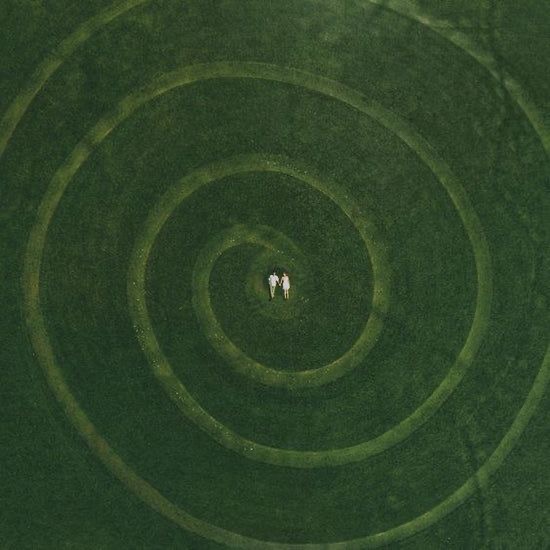
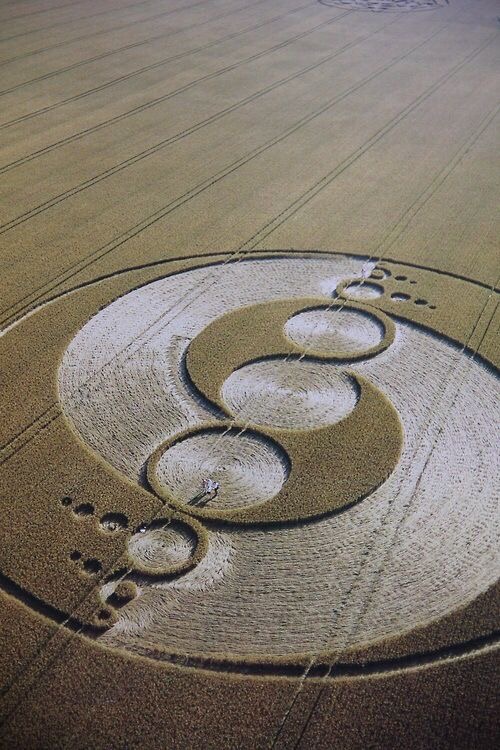
Desde hace décadas, los llamados crop circles han fascinado por igual a científicos, místicos y artistas: ¿son mensajes extraterrestres, geometría sagrada o la intervención creativa más enigmática del siglo XX?
El cine los inmortalizó. En Señales (2002), M. Night Shyamalan convirtió los círculos en presagio de invasión, pero también en símbolo de fe.
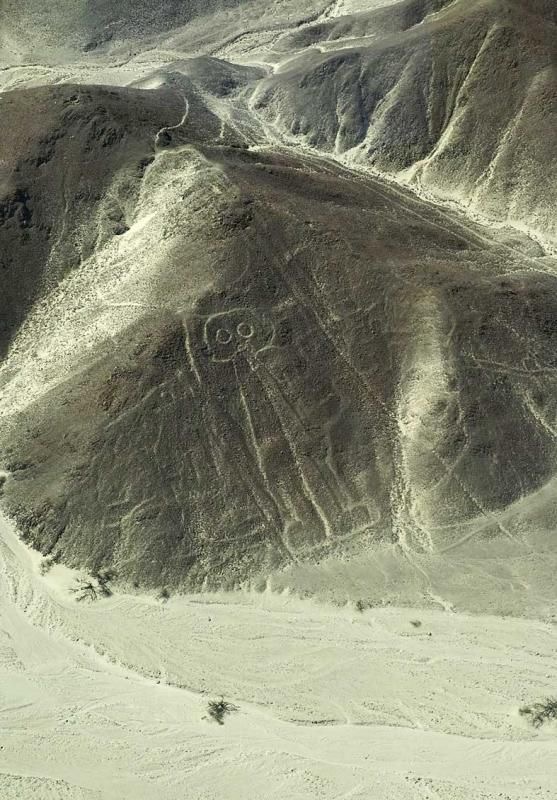
Aunque solemos pensar en los círculos de maíz como un fenómeno reciente, lo cierto es que la humanidad lleva milenios grabando símbolos gigantes en la tierra. En Perú, los geoglifos de Nazca crearon pájaros, monos y figuras humanas de cientos de metros de longitud, visibles únicamente desde el aire.
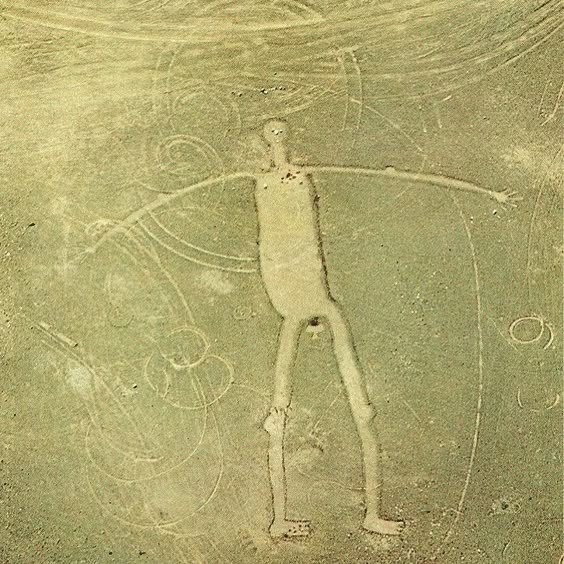
Algo similar ocurre con figuras menos conocidas pero igualmente poderosas: el geoglifo antropomorfo de Atacama en Chile, o representaciones humanas estilizadas en el desierto, con brazos abiertos y proporciones imposibles. Como si las culturas antiguas ya intuyeran que dibujar en la tierra era dialogar con el cielo.
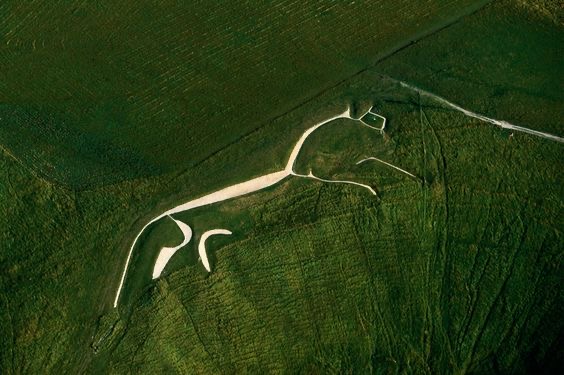
En Inglaterra encontramos otro ejemplo fascinante: el Caballo Blanco de Uffington, excavado hace más de 3.000 años en una ladera de colina. Con sus 110 metros de longitud y su cuerpo delineado con tiza blanca, el caballo es visible a kilómetros de distancia. No se sabe si fue símbolo solar, emblema territorial o un rito de fertilidad, pero sí sabemos que fue creado para ser visto desde lo alto, para que su forma brillara en el paisaje.
For decades, the so-called crop circles have fascinated scientists, mystics, and artists alike: are they extraterrestrial messages, sacred geometry, or the most enigmatic creative intervention of the 20th century?
Cinema immortalized them. In Signs (2002), M. Night Shyamalan turned the circles into omens of invasion, but also into symbols of faith.
Although we tend to think of crop circles as a recent phenomenon, humanity has been engraving giant symbols on the land for millennia. In Peru, the Nazca geoglyphs created birds, monkeys, and human figures stretching hundreds of meters, visible only from the air.
Something similar occurs with lesser-known yet equally powerful figures: the anthropomorphic geoglyph of Atacama in Chile, or stylized human forms carved into the desert, with outstretched arms and impossible proportions. As if ancient cultures already sensed that drawing on the earth was a way to converse with the sky.
In England, we find another fascinating example: the Uffington White Horse, carved more than 3,000 years ago into a hillside. At 110 meters long, its body outlined in white chalk, the horse can be seen for miles. Whether it was a solar symbol, a territorial emblem, or a fertility ritual remains unknown. What we do know is that it was created to be seen from above, to shine across the landscape.
Desde Nazca hasta Uffington, el ser humano ha buscado trazar símbolos que sólo los dioses o el cielo pudieran leer.
From Nazca to Uffington, humanity has sought to trace symbols that only the gods or the sky could read.
El arte contemporáneo de los círculos
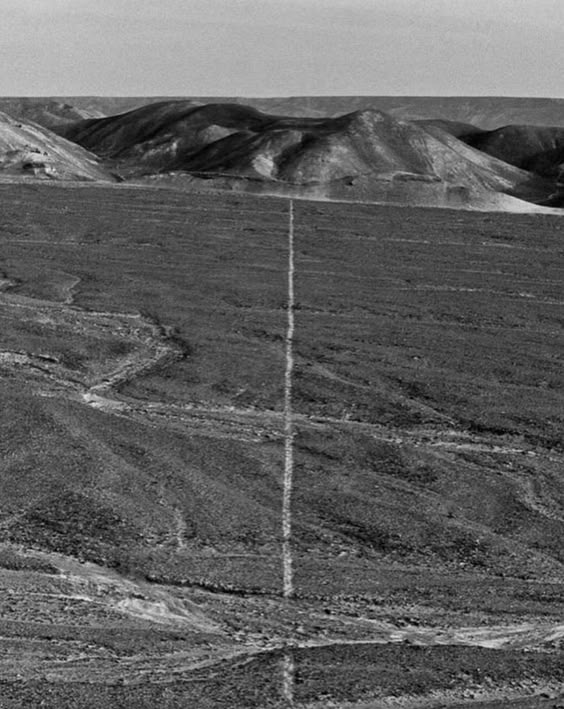
Más allá de lo inexplicable, los crop circles dialogan también con el arte moderno. En los años 60 y 70, el movimiento del Land Art propuso salir de los museos para trabajar directamente en la naturaleza. Richard Long trazaba caminos al caminar repetidamente sobre un terreno; Andy Goldsworthy construía esculturas efímeras con piedras, hojas o hielo que desaparecían con el paso del tiempo.
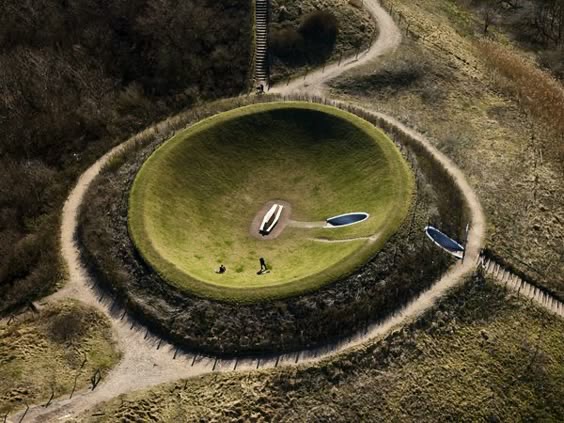
Otros, como James Turrell con su proyecto Roden Crater, transformaron montañas enteras para convertirlas en observatorios de luz y cielo. Aunque diferentes, estas obras comparten con los círculos la fascinación por lo cósmico y la escala desmesurada.
En muchos casos, los círculos de maíz fueron diseñados por artistas anónimos con una perfección matemática que desafía la lógica. Para algunos eran engaños; para otros, esculturas efímeras de geometría sagrada: intervenciones artísticas radicales que juegan a ser mensaje extraterrestre y, al mismo tiempo, instalación poética.
The contemporary art of circles
Beyond the inexplicable, crop circles also converse with modern art. In the 1960s and 70s, the Land Art movement proposed leaving museums behind to work directly in nature. Richard Long marked paths by repeatedly walking over terrain; Andy Goldsworthy built ephemeral sculptures with stones, leaves, or ice that vanished with time.
Others, like James Turrell with his Roden Crater project, transformed entire mountains into observatories of light and sky. Though different in form, these works share with the circles a fascination for the cosmic and the monumental.
In many cases, crop circles were designed by anonymous artists with a mathematical precision that defies logic. For some they were hoaxes; for others, ephemeral sculptures of sacred geometry: radical artistic interventions that play at being extraterrestrial messages while also becoming poetic installations.
Esos extraños círculos en las plantaciones o en los cultivos, lo hablé bastante con mi padre. En aquella época sentía un miedo a lo desconocido y me desbordaban muchas preguntas, de las cuales dudaba si quería saber su respuesta. Mi padre curioseaba mucho en ciertos temas, como si ciertos enigmas también desbloquearan a uno por dentro.
Those strange circles in the fields, I talked about them a lot with my father. At that time, I felt a deep fear of the unknown, and I was overwhelmed by so many questions that I wasn’t sure I even wanted to know their answers. My father was deeply curious about certain subjects, as if some enigmas could also unlock something within oneself.
Quizá por eso los crop circles me resultan tan magnéticos. No sé si son mensajes de otros mundos, símbolos espirituales o manifestaciones de arte humano. Pero sí sé que son puertas a la pregunta, y que en esa pregunta reside su fuerza.
Algunos ven en ellos geometría sagrada: la flor de la vida, espirales áureas, símbolos que aparecen en culturas ancestrales. Otros, un juego humano entre el arte y la provocación.
“Los círculos actúan como espejos: nos obligan a elevar la mirada, a pensar en escalas más grandes que la nuestra.”
Quizá el misterio no esté en quién los hace, sino en lo que provocan. Nos invitan a imaginar, a creer que aún existen mensajes que no entendemos del todo.
Maybe that’s why crop circles feel so magnetic to me. I don’t know if they are messages from other worlds, spiritual symbols, or manifestations of human art. But I do know they are gateways to the question—and in that question lies their power.
Some see in them sacred geometry: the flower of life, golden spirals, symbols that appear across ancestral cultures. Others see a human play between art and provocation.
‘The circles act like mirrors: they force us to lift our gaze, to think in scales greater than our own.’
Perhaps the mystery does not lie in who makes them, but in what they provoke. They invite us to imagine, to believe that messages still exist which we do not fully understand.
En un mundo obsesionado con las respuestas inmediatas, la posibilidad del misterio es, en sí misma, un arte.
In a world obsessed with immediate answers, the possibility of mystery is, in itself, an art